Over 100 servers seized behind fake trading sites: why domain age matters
An operation led by German authorities on 3 November 2026 seized over 100 servers behind fake trading platforms that were allegedly supplied to criminal groups. Why the registration date is an early signal, and how the browser can act on it.
On 3 November 2026 an international operation led by German authorities, with support from Eurojust and Europol, shut down more than 100 servers and ended with seven arrests. The target was an investment fraud scheme built on trading platforms that looked legitimate and were allegedly supplied to criminal groups.
The detail that matters to a security team is the supply side. According to the reporting, these sites were not thrown together by each scammer. When one provider serves many groups, there are many sites to launch and many to replace, and a replacement means a new domain. A new domain is something a browser can see on the first click.
What happened
Europol describes coordinated action on 3 November 2026 by authorities in Albania, Cyprus, Finland, Germany, Kosovo and North Macedonia, supported by Europol and Eurojust. The scheme had potential victims in more than 50 countries. Eurojust says the action followed earlier arrests and searches in 2022 and 2025, and puts the estimated losses at over EUR 4 million.
A report published the same day by KuCoin News, relaying CoinEdition, adds more detail. It describes a seven country operation led by German authorities after four years of investigation, with the latest raids covering 17 locations. It says seven suspects are being prepared for extradition to Germany.
The same report says investigators traced the network after a German couple reported withdrawal difficulties in 2022. Later operations in 2022 and 2025 reportedly uncovered evidence linking the platform providers to the call centres that worked the victims.
How the scam works
The suspected network supplied criminal groups with websites advertising profitable cryptocurrency, forex and stock investments. The platforms displayed made up profits so that investors believed their deposits were growing.
The pattern reported is a familiar one:
- The lure. Online advertisements attract investors. The report says criminal groups allegedly bought personal information gathered through advertising campaigns.
- The call. That information was used to approach victims through call centres.
- The small deposit. Victims are first asked for a small amount, while the platform shows made up profits.
- The large deposit. Victims are encouraged to invest more. Fake brokers keep up the pressure and discourage withdrawals.
Nothing in this chain needs malware or a stolen password. The victim visits a website, creates an account and sends money. That is why it is easy to miss from the security side. It looks like a person making a bad decision on a website, not an intrusion.
Why the registration date is an early signal
A blocklist knows what someone has already reported. A fake trading site usually has to be reported by a victim, investigated by a vendor and then added to a feed. Each step takes time, and during that time the site is open for business.
Now think about how a supplier of fake platforms works. If one provider serves many groups, there are many sites to replace when one is reported or taken offline. Replacing a site means registering a new domain. We cannot see inside this particular network, and we are not claiming to. But as a general pattern, a scam site is most useful to its operators while it is new, and a new site sits on a domain with no history.
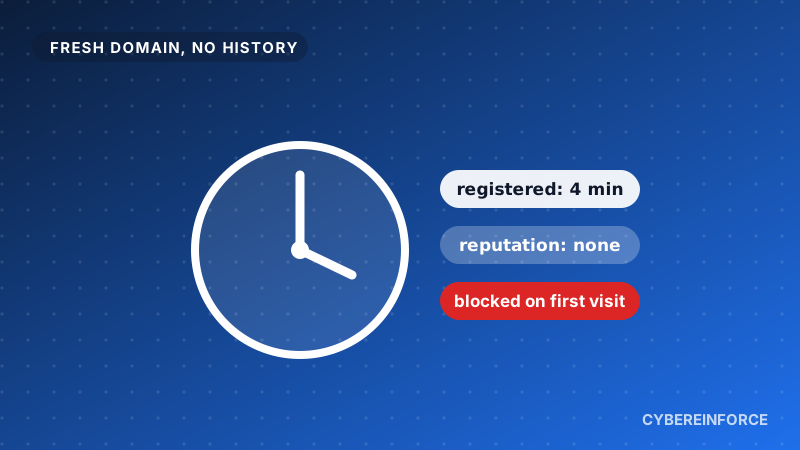
That makes the age of the domain a signal you can check on the first visit. The domain does not need a bad reputation. It only needs to be too young to have any reputation at all. A legitimate broker that your staff have a reason to visit will normally have been around for a while. A site registered last month asking for a deposit deserves a very different level of trust.
This also matters for staff who are not being scammed at work. An employee who follows an advertisement during a break, on a company laptop or a managed phone, opens it in the same browser your security controls cover. That browser is the one place where the click can be checked before a form is filled in.
What to do
- Treat domain age as a first class signal. Where your tooling allows it, add the registration date to the information your SOC sees next to a URL.
- Brief your staff on investment lures. Small first deposits, platforms showing fast profit, a friendly "broker" who calls, and difficulty withdrawing are the pattern. Make it easy to report a link and a phone call.
- Do not rely on takedowns for protection. Operations like this one take years. The investigation described above began in 2022, and the servers were seized in 2026. People are exposed in the meantime.
- Check a site before you trust it. The free IOC Lookup lets anyone check a domain or URL.
- Enforce in the browser. The browser is where the click happens, so it is where a young domain can be stopped before a deposit is made.
How you would be protected with Cybereinforce
- New domains get no free pass.* A domain registered in the last six months is blocked in the browser, and one between six and twelve months old shows a warning. This happens on the first click, before anyone has reported the site.
- Rotating to fresh domains does not help. When a site is replaced by a copy on a new domain, the copy is a new domain too. Coverage spans newly registered domains across 1,100+ TLDs, and Certificate Transparency logs are read continuously.
- Every block shows its reason. Your SOC sees an explanation such as "domain registered 3 days ago", so there is no guessing about why a user was stopped.
- Your SOC sees every attempt. Each block becomes an event with the user, the URL and the reason, ready for Microsoft Sentinel and working alongside Microsoft Defender.
- The same protection in every browser. Cybereinforce runs in Chrome, Edge, Firefox and Safari on Windows, macOS, iPhone and iPad, and administrators deploy it in minutes. There is a free 14 day trial with no credit card, and it is sold through Microsoft Marketplace.
* In browsers protected by Cybereinforce.
- Eurojust: International investment fraud scheme dismantled: seven arrests (November 2026)
- Europol: Investment scams with potential victims in at least 50 countries: over 100 servers seized (November 2026)
- KuCoin News (CoinEdition): Europol Seizes Over 100 Servers in International Investment Scam Crackdown (November 2026)