Trigram: About 50 Fake Brands Ask Developers to Paste a Command
Stormshield's Trigram research describes about 50 impersonated AI and blockchain brands that get developers to run an infostealer themselves. Here is how the lure works, and how a browser block becomes a Sentinel event your SOC can act on.
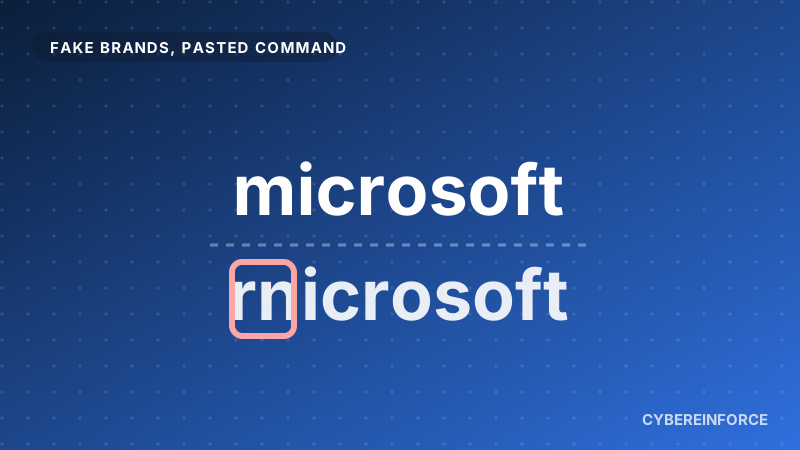
On 17 November 2026 Stormshield published a deep dive on a campaign it calls Trigram. About 50 AI and blockchain brands are impersonated, and the goal is to get a developer to run an infostealer on their own machine. The malware does not need an exploit, because the visitor is asked to paste the command.
That makes the first visit to the fake site the moment that matters. The browser is where it happens, and it is also where it can be stopped and recorded.
What happened
Stormshield describes Trigram as a large scale campaign that impersonates about 50 brands in the blockchain and AI sectors, to trick developers into executing an infostealer themselves. The Hacker News reported the research the same day. Targets are in Europe and the United States, in the AI, blockchain and logistics sectors.
Three social engineering scenarios feed the same infrastructure and the same payload:
- Recruitment. Fake job offers send developers to sites that imitate a recruitment platform. One reported example is a fake careers portal impersonating Amber Group.
- Conference. Conference invitation sites are part of the same infrastructure.
- Package tracking. Package delivery sites sit on the same infrastructure, which is why the logistics sector is named as a target.
The reporting links Trigram to the UNK_DeadDrop cluster. Stormshield assesses with high confidence that it continues that cluster, with a change in how it delivers. The activity also shows similarities with intrusion sets tied to North Korea, in particular Kimsuky, and UNK_DeadDrop itself resembles the long running Contagious Interview activity. SafeDep, whose analysis The Hacker News quotes, adds a caution: the match rests on technique and does not prove who the operators are.
There is also a supply chain branch. A forged commit was pushed to the antd-img-crop GitHub repository on 31 October 2026. It installs malware through a prebuild hook as soon as a developer runs the build command. The npm package itself was not affected.
How the attack works
The recruitment path is the most detailed one in the reporting. It starts with an email about a job, and it is built to filter its visitors.
- The email and the site. The link opens a site that looks like a recruitment platform, with job listings and an application form.
- Filtering in the background. The page fingerprints the visitor and uses IP based geofencing. Visitors from certain regions get a stripped down home page with nothing to click.
- A referral code. The applicant is asked for an invitation code. That suggests pre identified targets rather than a broad audience. A rejected code produces one of three messages: already used, locked to another IP, or invalid.
- A technical check. If the code is accepted, the candidate is told to copy a command and run it in a terminal. The first run only sends a value shown on the page to a remote server, and the page then shows a timeout error.
- The Copy button changes. On the next screen the Copy button puts a different command on the clipboard, even if the user copies with the keyboard. The command depends on the operating system: PowerShell on Windows, bash on Linux and macOS. It fetches a loader script.
The loader sets up Node.js if a suitable version is missing, then fetches a JavaScript payload called install_guard.js. That payload deploys an infostealer that collects system information, browser credentials, cryptocurrency wallets and sensitive files. In the forged commit variant, SafeDep reports theft of browser passwords, cookies, keychains, wallets, SSH keys and .env files on macOS, Linux and Windows, plus a remote access agent disguised as Google software.
Behind the sites sits a back office that tracks victims. The reporting describes a console that records every action a visitor takes. It also rates each real visitor as important, moderate or useless, and it keeps tabs on bot visitors and on lookalike domains that have been taken down. The same JavaScript bundle is served to everyone, and the hostname or URL path decides which interface appears. The operators also rely on legitimate services, including GitHub and GitLab for hosting and several email delivery platforms.
Why it works
Nothing in this chain needs a vulnerability. The user opens the site, the user copies the command, the user runs it. The operating system sees an authorised person typing in their own terminal.
The lure is also credible for its audience. Developers apply for jobs, accept coding assessments, attend conferences and receive packages. A site that looks like a known AI or blockchain company, asks for a referral code and then offers a "technical check" fits what a developer expects from a hiring process.
Finally, the infrastructure changes. Stormshield observed a C2 rotation while it was analysing the campaign, and the back office tracks lookalike domains that have been taken down. Replacing domains looks like part of the routine, and a block list built from yesterday's reports is one domain behind.
What to do
- Treat any "paste this command" step as a stop sign. A recruiter, a conference organiser or a courier tracking page has no reason to ask a candidate to run a command in a terminal. Put that sentence in your developer awareness material.
- Review the build path. The forged commit ran its code through a prebuild hook. Check what your pipelines and developer machines execute before and during a build, and review recent commits to dependencies you pin or clone.
- Hunt for the artefacts. The reporting lists names worth searching for in endpoint telemetry: install_guard.js, loader files named v.cmd, u and verify_m, and a Node.js 20.18.1 install that nobody on the team requested. The back office was reported at 170.205.30[.]27:8000, and asteara[.]org was flagged as related infrastructure for UNK_DeadDrop.
- Check a suspicious domain. The free IOC Lookup lets anyone check a domain or URL.
- Rotate after a run. If someone did run the command, treat browser passwords, session cookies, SSH keys, wallet seeds and .env secrets on that machine as exposed.
How you would be protected with Cybereinforce
- Your SOC sees every attempt. Each block becomes an event with the user, the URL and the reason, ready for Microsoft Sentinel and working alongside Microsoft Defender. A developer who followed a fake recruiter link becomes something your SOC can investigate.
- New domains get no free pass.* A domain registered in the last six months is blocked in the browser, and one between six and twelve months old shows a warning. This happens on the first click, before anyone has reported the site. Rotating to fresh domains does not help when fresh domains are exactly what gets blocked.
- Brand lookalikes are caught from minute one.* Domains that imitate well known brands are caught on the first click, before any reputation exists. Newly registered domains across 1,100+ TLDs are covered, and Certificate Transparency logs are read continuously.
- The exact page is blocked, not the whole service.* Cybereinforce blocks on the full URL path, not only the domain. The phishing page is stopped while the rest of the platform keeps working.
- Your Defender indicators reach every browser. Cybereinforce reads the indicators your team already maintains in Defender and enforces them inside the browser itself, in Chrome, Edge, Firefox and Safari on Windows, macOS, iPhone and iPad. Administrators deploy it in minutes.
* In browsers protected by Cybereinforce.